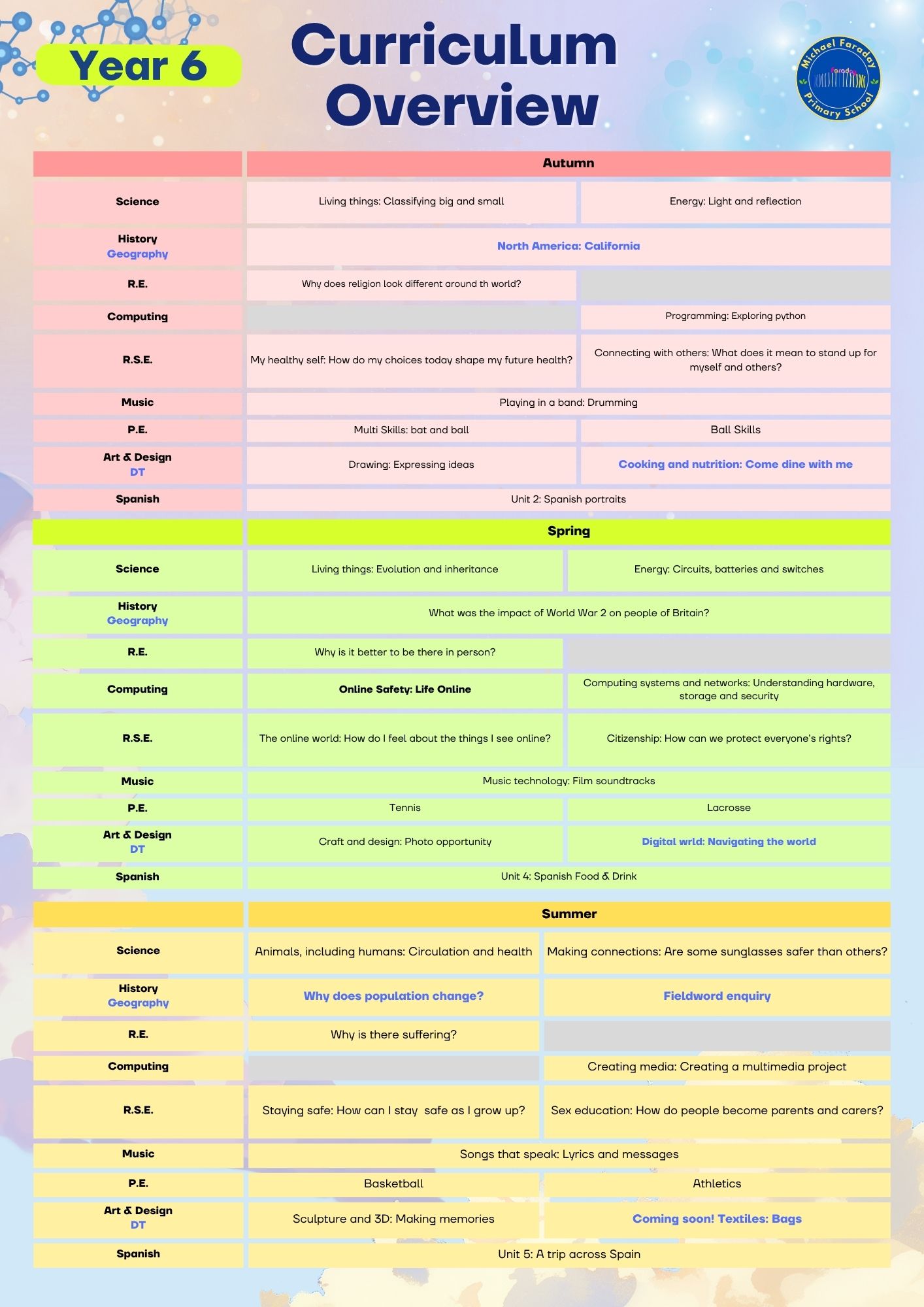
Year 6
“No one is born hating another person because of the colour of his skin, or his background, or his religion. People must learn to hate, and if they can learn to hate, they can be taught to love, for love comes more naturally to the human heart than its opposite.”
Nelson Mandela
Reading
We follow whole-class reading comprehension approach. Children answer questions on vocabulary (meaning of words), retrieval (finding information “on the line”), inference (“between the lines” – using clues to interpret), prediction (thinking “beyond the lines”) and summarising (VIP = very important points), compare, contrast, comment and author's choice. These are the key reading skills assessed in the Year 6 SATs and, more importantly, help children become confident, thoughtful readers.
Please encourage your child to read regularly at home, preferably chapter books and ensure that any reading comprehension homework is completed.
Writing
Talk4Writing approach: We use high-quality model texts to explore the structure of narratives and the features of non-fiction. Children then apply the language, structure and writing techniques to create their own writing. We place a strong emphasis on developing secure secretarial skills, including accurate spelling, legible joined handwriting, correct grammar and pride in presentation.
SPAG
Through SPAG lessons and regular SATs-style practice, children develop their grammar, punctuation and spelling knowledge, learning to apply these skills accurately in both the SPaG test and their independent writing.
Maths
Children develop fluency and confidence in number and calculation through the Big Maths approach, while also applying their learning across wider maths, including fractions, geometry, measurement and statistics. Throughout the year, children will build their reasoning and problem-solving skills in preparation for the Year 6 SATs. Please encourage your child to complete their Mathletics homework each week, as this provides valuable practice and reinforces their learning.